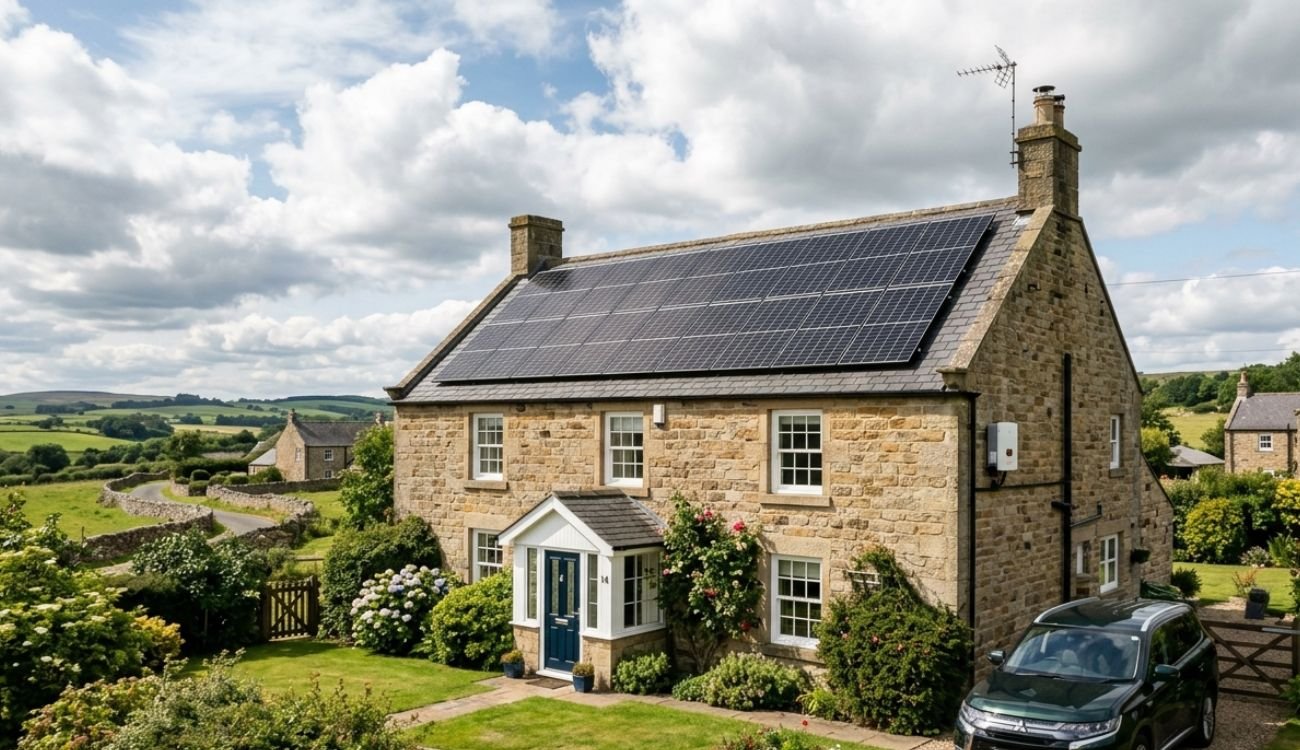

Most UK homeowners need between 4 and 12 solar panels to run an air conditioner, but the exact number depends on the type of air con unit, its energy consumption, and the size of your solar PV system.
Understanding how many solar panels needed to run an air conditioner properly could save you a significant amount of money on your energy bills, especially during those warmer months when both your AC and your solar panels are working hardest.
This guide breaks everything down in plain terms, with real figures based on current UK conditions. Whether you live in Newcastle, Sunderland, Gateshead, or anywhere else in the North East, this is everything you need to know before making a decision.
How Many Solar Panels Are Needed to Run an Air Conditioner in the UK?
The number of solar panels needed to run an air conditioner in the UK typically ranges from 4 to 12 panels, depending on the size and type of your air con unit.
A small portable unit drawing 500 to 900 watts needs around 3 to 4 panels rated at 400W each, while a larger wall-mounted split system using 1.5 to 2.5 kW needs between 6 and 9 panels. For the biggest residential systems, you could be looking at closer to 10 to 12 panels.
Here is a practical breakdown based on real UK figures:
| Air Conditioner Type | Typical Power Draw | Solar Panels Needed (400W panels) |
|---|---|---|
| Small portable unit (500–900W) | 0.5–0.9 kW | 3–4 panels |
| Mid-size portable unit (1,500–2,000W) | 1.5–2 kW | 5–7 panels |
| Wall-mounted split system (small) | 0.5–1.5 kW | 3–5 panels |
| Wall-mounted split system (medium) | 1.5–2.5 kW | 6–9 panels |
| Larger multi-room split system | 2.5–4 kW | 9–12 panels |
Keep in mind that these figures cover daytime operation only. If you want to run your air con into the evening, you will need a battery storage system to store the energy your panels generate during the day.
Why Factors Determine How the Number of Panels Needed to Run An Air Conditioner?
The variation comes down to a combination of your air conditioner’s wattage and how much sunlight your panels actually capture on a given day. In the North East of England, peak sun hours average between 2.5 and 3.5 hours per day in summer, which is somewhat lower than southern England, where panels can benefit from up to 4 to 4.5 hours of peak sun. This matters a great deal when sizing a solar system.
A 400W panel in northern England typically generates around 2.7 to 3.5 kWh per day during summer. That means each panel is doing a good but not exceptional amount of work compared to panels installed further south.
The good news is that modern high-efficiency panels compensate well for this, and a well-designed system still provides excellent performance right across Tyne and Wear and County Durham.
The Role of Your Air Conditioner’s Wattage
The wattage your air conditioner draws is the single biggest factor in determining how many panels you need. A modern wall-mounted split system, which is the most energy-efficient type available in the UK, typically draws as little as 480 watts per hour, while a portable unit can consume anywhere from 2,900 to 4,100 watts.
That is a massive difference, which is why two homeowners with very different setups can end up needing very different numbers of panels.
Peak Sun Hours in the North East
The North East does not get as much sunshine as Cornwall or Kent, and it is worth being honest about that. However, the region still receives enough annual solar irradiance to make solar panels a genuinely worthwhile investment.
In the Midlands and North of England, you can typically expect around 950 to 1,000 kWh of generation per kW of installed capacity per year, compared to around 1,100 kWh in the South. That figure still stacks up very favourably, particularly when solar panel costs have continued to fall year on year.
Solar and Air Con in Summer vs Winter
In summer, solar output in the North East reaches its peak, with a 400W panel generating up to 3.5 kWh on bright days. Running a split-system air conditioner during the day in these conditions is often entirely covered by solar alone. In winter, panel output drops significantly to around 1.1 to 1.8 kWh per day per panel, which is far less useful for powering an AC unit. That said, most homeowners are not running air conditioning in a North East winter, so this is rarely a practical concern.
How to Calculate the Number of Panels Needed to Run An Air Conditioner?
Working out your specific requirement is simpler than it might seem. You need two pieces of information: your air conditioner’s wattage (found on the unit or in its manual) and your daily usage in hours.
Step 1: Find Your AC’s Daily Energy Use
Multiply the wattage by the number of hours you run it per day. For example, a 1,500W split system running for 6 hours uses 9 kWh per day.
Step 2: Account for North East Solar Output
In the North East during summer, a 400W panel typically generates around 2.7 to 3 kWh per day.
Step 3: Divide and Round Up
Divide your daily energy requirement by the per-panel output. Using the example above: 9 kWh divided by 3 kWh per panel equals 3 panels. In practice, you would round up and add a buffer to account for cloudy days, shading, and panel degradation. A minimum of 5 to 6 panels would be more realistic for that scenario.
This calculation covers the air conditioner alone. Your home also draws power for lighting, appliances, and other devices, so a full household system needs to factor in your total consumption, not just the AC.
What Size Solar System Do You Need for Air Conditioning?
For most UK homeowners running a single air conditioning unit alongside their regular household usage, a 4 kW to 6 kW solar PV system is the recommended starting point.
- 4 kW system (10 to 12 panels): Suitable for homes with a small to medium split-system air conditioner and normal household usage.
- 5 to 6 kW system (13 to 16 panels): Better suited to larger homes or those running a more powerful air conditioning unit alongside the usual appliances.
- 6 kW+ system with battery storage: The most capable setup for homes wanting to use air conditioning in the evenings or during overcast periods, with a 5 to 10 kWh battery providing the backup needed.
A standard 4 kW system in the UK costs between £5,000 and £9,000 installed in 2026, depending on the panels chosen, the inverter type, and installation complexity. Adding battery storage typically brings the combined cost to £9,000 to £15,000.
Given that a well-sized solar system can save homeowners between £783 and £1,567 per year on electricity bills, the payback period for a 4 kW system is generally around 6 to 7 years.
Does Solar Power Work Well With Air Conditioning in the North East?
Solar power actually pairs extremely well with air conditioning in the North East, and the timing works in your favour. Your solar panels generate the most electricity on warm, sunny summer days, and those are exactly the days when you want to run your air con. The two demands are well matched.
The main caveat is that the North East sees shorter daylight hours and more overcast days than southern England. This does not make solar unviable by any stretch, but it does mean that choosing the right system size matters more here than it would in, say, Bristol or Brighton.
A correctly sized system installed by an experienced local installer will account for regional solar irradiance data specific to your area, whether that is Newcastle, South Shields, Durham, or Hexham.
Should You Add Battery Storage?
Battery storage is worth serious consideration if you want your solar-powered air conditioning to work beyond daylight hours. A 5 kWh home battery can store enough solar energy to run a mid-sized split-system air conditioner for several hours in the evening. A 10 kWh battery gives even greater flexibility.
The benefit goes beyond air conditioning. Battery storage allows you to use solar-generated electricity for everything from cooking to charging electric vehicles, reducing your reliance on the grid across the board. With UK electricity prices sitting at around 24.5p per kWh in 2026, every unit of stored solar energy you use instead of grid power puts money back in your pocket.
Is Running Air Conditioning on Solar Panels Worth It?
Yes. Running air conditioning on solar panels is absolutely worth it for most UK homeowners, provided the system is correctly sized. The cost of running a portable unit from grid electricity alone can reach over £166 over a three-month summer period, while a wall-mounted split system on the grid still costs around £86 per month at continuous use.
With solar generation covering those costs during the day, the savings are tangible and consistent year after year.
There is also the broader value of a solar PV system to consider. Panels are not installed just to power your air conditioning. They reduce your overall electricity bill, offer some protection against rising energy prices, and can increase the value of your property.
In the North East, homeowners who have made the switch to solar-powered homes with efficient climate control consistently report lower energy bills and greater comfort through warmer spells. The technology has matured considerably, and the combination of falling panel prices and sustained electricity costs makes 2026 a strong time to act.
Get a Free Solar Panel Quote From Future Heat Ltd
If you are based in Tyne and Wear, Newcastle, or anywhere across the North East of England, Future Heat Ltd is ready to help you take the next step towards solar-powered living. Our team has extensive experience designing and installing solar PV systems for homes across the region, and we know exactly how to size a system that works for your property, your energy needs, and your local conditions.
Whether you are looking to power an air conditioning unit, reduce your electricity bills, or simply make your home more energy-independent, we offer a completely free, no-obligation solar panel quote tailored to your home.
Frequently Asked Questions
Can I run air conditioning solely on solar panels without connecting to the grid?
Yes, it is possible to run air conditioning entirely off-grid using solar panels combined with a large battery storage system. To do this reliably in the North East, you would need a system of at least 6 to 8 kW with a battery bank of 10 kWh or more to cover periods of low sunlight and evening use.
Most households choose a hybrid approach, using solar as the primary source and the grid as a backup, which is a more cost-effective and practical setup for most homes.
Does the direction my roof faces affect how many panels I need for my air conditioner?
Roof orientation has a significant impact on solar output. A south-facing roof at a pitch of 30 to 40 degrees gives the best year-round generation in the UK. East or west-facing roofs still generate usable energy, but output can be 15 to 20% lower than south-facing, meaning you may need one or two additional panels to generate the same amount of energy for your air con.
Will my solar panels still power my air conditioner on a cloudy day?
Solar panels do still generate electricity on overcast days, just at a reduced rate. On a heavily overcast summer day in the North East, a 400W panel might produce 0.5 to 1 kWh rather than its summer peak of 3 to 3.5 kWh. For uninterrupted air conditioning during low-light periods, a battery or grid connection is recommended to fill the gap.
Do I need planning permission to install solar panels for air conditioning in the North East?
In most cases, solar panel installations on domestic properties in England fall under Permitted Development rights, meaning no planning permission is required. Exceptions apply to listed buildings, properties in conservation areas, and some homes with unusual roof configurations.
It is always best to confirm with your installer before proceeding, and Future Heat Ltd can advise you on this as part of the free consultation process.
What is the difference between a solar-ready air conditioner and a standard unit?
Some modern air conditioning units are specifically designed for compatibility with solar PV systems. These units often include DC-powered compressors or variable-speed drives that respond more efficiently to the fluctuating power output that solar panels naturally produce.
While a standard air conditioner will work perfectly well with a solar system through a standard inverter, a solar-compatible unit can improve efficiency by 10 to 30%, potentially reducing the number of panels you need.

Jamie Maguire is Managing Director at Future Heat Ltd, the UK-based renewable energy company specialising in heat pumps, solar panels and energy-efficient boiler solutions. He leads the company’s strategic vision to decarbonise homes and businesses across the UK by delivering innovative, sustainable heating and power systems. Jamie is passionate about shaping the future of energy, supporting communities and empowering teams of skilled engineers to deliver lasting value and carbon reductions nationwide.