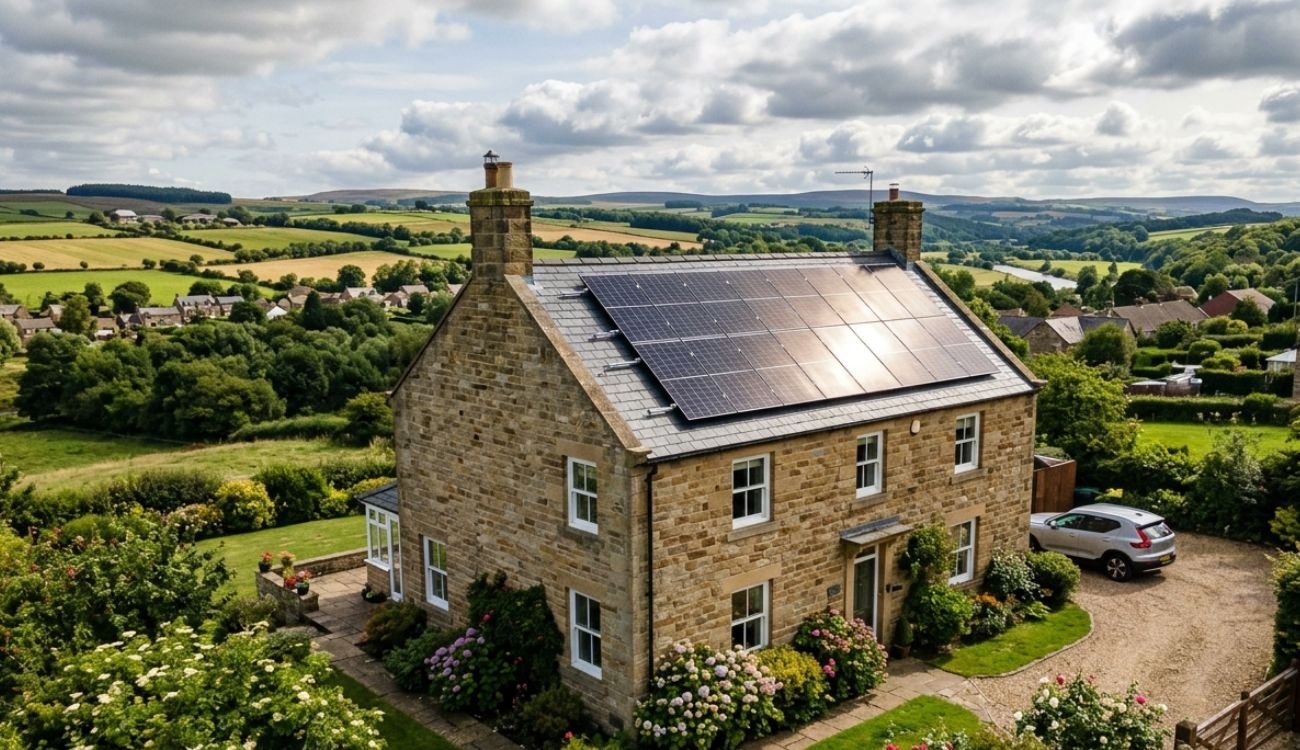

Choosing the right solar panels for your home is one of the most important decisions you will make when switching to renewable energy. Get it right, and you could be cutting your electricity bills significantly and enjoying clean, low-cost power for decades. Get it wrong, and you could end up with panels that underperform, a system that is too small, or an installer who leaves you with no access to government incentives.
This guide walks you through everything you need to know so you can choose solar panels for your home with confidence.
Whether you are based in Newcastle, Gateshead, South Tyneside, or anywhere across the wider North East, the advice here is grounded in real UK conditions and current 2026 regulations.
What Should You Consider When Choosing Solar Panels for Your Home?
Choosing solar panels for your home requires thinking about several key factors together, not just one in isolation. The type of panel, its efficiency rating, your roof’s orientation, the system size, and the installer you choose all play a role in how well your system performs over its lifetime.
A common mistake homeowners make is focusing purely on price. A cheaper panel that degrades quickly or an installer who cuts corners can end up costing you far more in the long run. The sections below break each factor down clearly so you know exactly what to look for.
Which Type of Solar Panel Is Best for a UK Home?
The best type of solar panel for most UK homes is monocrystalline. These panels are made from a single, pure silicon crystal, which allows electricity to flow through them more efficiently than other panel types.
There are three main types available:
- Monocrystalline panels achieve efficiency ratings of around 19% to 23%, perform well in low-light conditions, and are the default choice for UK homes due to their compact size and high output.
- Polycrystalline panels have efficiency ratings of around 15% to 18% and carry a lower upfront cost, but require more roof space to generate the same amount of electricity.
- Thin-film panels are lightweight and flexible, with efficiency ratings of around 10% to 13%, making them better suited to portable or curved surfaces rather than a typical UK roof.
Given that most UK homes have limited roof space, monocrystalline panels are almost always the practical choice. They produce more electricity per square metre, which matters particularly on a terrace or semi-detached property in the North East where every centimetre of usable roof counts.
What About the Newer Panel Technologies?
Beyond the three standard types, there are newer technologies worth knowing about. TOPCon (Tunnel Oxide Passivated Contact) and HJT (Heterojunction Technology) panels represent the current frontier in residential solar. These commercial-grade panels can achieve efficiencies of 22% to 24% or higher and are becoming more available to homeowners.
Panels like the AIKO NEOSTAR 3N+78, which tops several UK efficiency rankings, achieve up to 25.2% efficiency. The DMEGC Infinity and SunPower Maxeon 7 are also widely cited by UK installers as excellent all-round performers.
For most homeowners in Tyne and Wear, a high-quality monocrystalline panel from a reputable brand, installed by a certified professional, will deliver outstanding results.
Does Location Affect How Many Panels You Need?
Yes, it does. The North East of England receives between 1,337 and 1,456 hours of sunshine annually, which is more than many people expect. That said, it is slightly less than southern England, so homes in Newcastle or South Tyneside may need a marginally larger system to match the output of an equivalent system installed further south.
A professional installer like Future Heat will calculate this precisely for your specific address.
Does Your Roof Orientation Really Matter?
Roof orientation matters a great deal. South-facing roofs receive the most consistent sunlight throughout the day in the UK, because the sun always passes through the southern part of the sky in the Northern Hemisphere.
A 4 kWp south-facing system in the North of England typically generates between 3,400 and 4,200 kWh per year, depending on shading and local conditions.
However, having a south-facing roof is not essential. East and west-facing roofs can still perform well, often producing 80% to 90% of the output of a south-facing setup. This is especially true when panels are installed on both sides of the roof, capturing morning and afternoon sun respectively.
What Angle Should Solar Panels Be Installed At?
The ideal tilt angle for solar panels in the UK is between 20° and 50°, with around 30° to 35° considered optimal for most installations. Further north, such as in Newcastle and the surrounding area, a slightly steeper angle of around 35° to 40° helps capture lower winter sun more effectively.
Most residential roof pitches in the UK fall within this ideal range, which means a standard roof-mounted installation is already close to the optimal angle without needing any special mounting adjustments.
How Do You Know What Size Solar Panel System to Get?
The right system size balances three things: your energy usage, your available roof space, and your budget. A system that is too small will leave you relying heavily on the grid. A system that is too large may generate more electricity than you can use or export.
The most practical approach is to start with your energy bills. If your household uses around 3,000 kWh per year, a 4 kWp system with 10 to 12 monocrystalline panels would cover a significant portion of that. If you are planning to add an electric vehicle charger or a battery storage system in the future, it is worth sizing up now rather than retrofitting later.
Adding battery storage allows you to store surplus electricity generated during the day and use it in the evening. When combined with solar panels and a heat pump, homeowners can potentially cut their energy bills by up to 90%.
What Solar Panel Efficiency Rating Should You Look For?
For residential installations in the UK, aim for panels with an efficiency rating of at least 19% to 20%. This ensures you get a strong output from a compact roof area.
Here is a quick reference:
- 19% to 21% efficiency: Solid performance, widely available, suitable for most homes
- 21% to 23% efficiency: Premium output, ideal for limited roof space or high energy users
- 23% and above: Cutting-edge technology (TOPCon, HJT), highest output per panel
Panel efficiency degrades slightly over time. Quality panels from reputable brands typically degrade at less than 0.5% per year, meaning a panel rated at 400W today should still be producing around 90% of that output 20 years from now. When comparing panels, always check the manufacturer’s degradation rate as part of your assessment.
Should You Add Battery Storage With Your Solar Panels?
Pairing solar panels with a battery storage system is increasingly popular among UK homeowners, and for good reason. Without storage, any electricity your panels generate that you do not immediately use gets exported back to the grid. With storage, that surplus is held in a battery and used whenever you need it, whether that is in the evening or during a cloudy spell.
Battery storage works particularly well in the North East, where autumn and winter days are shorter. A battery helps you make the most of every unit of electricity your panels produce, rather than losing it to the grid at a low export rate.
Through the Smart Export Guarantee (SEG), you can earn between 4p and 15p for every kWh you export. But given that electricity currently costs around 24p per kWh to buy from the grid, using your own stored electricity is worth considerably more than exporting it.
Why Does the Installer You Choose Matter So Much?
The quality of your installer has a direct impact on your system’s performance, safety, and your access to financial incentives. Only MCS-certified installers can issue the certificates needed to qualify for the Smart Export Guarantee. Without MCS certification, you may lose access to payments and certain grant schemes entirely.
MCS (Microgeneration Certification Scheme) is the UK’s primary accreditation standard for renewable energy installations. An MCS-certified installer follows strict guidelines covering system design, product selection, installation quality, and compliance with UK safety standards including BS 7671.
When assessing an installer, look for:
- MCS certification as a baseline requirement
- Positive independent reviews on platforms like Checkatrade or Trustpilot
- Experience installing in your local area (weather conditions and roof types vary by region)
- Clear, written warranties covering both the panels and the installation workmanship
- Transparency about ongoing maintenance and what happens if something goes wrong
Future Heat Ltd is MCS certified and has been providing solar PV installations across South Tyneside, Newcastle, and the wider North East for several years, with a strong track record of local reviews.
How Long Do Solar Panels Last and What Warranties Should You Expect?
Solar panels are built to last. Most quality residential panels come with a 25-year performance warranty and a separate 10 to 15-year product warranty covering defects.
The performance warranty guarantees that the panel will still produce a certain percentage of its rated output after a set period, typically 90% after 10 years and 80% after 25 years. Some premium brands like SunPower Maxeon offer stronger warranties, which is one of the reasons they score highly in expert reviews.
When reviewing warranties, pay attention to two things in particular. First, check whether the warranty covers just the product or includes the installation as well. Second, make sure the manufacturer has a track record of honouring warranties, as a 25-year guarantee is only as good as the company behind it.
Get a Free Solar Panel Quote From Future Heat Ltd
If you are ready to take the next step, Future Heat Ltd is here to help. We are an MCS-certified solar panel installer serving Tyne and Wear, Newcastle, South Tyneside, and the wider North East of England.
Our team will assess your home, your energy usage, and your roof orientation to design a solar PV system that genuinely suits your needs and budget. We will also advise on battery storage, the Smart Export Guarantee, and any grants you may be eligible for.
Getting started is straightforward. Request your free, no-obligation solar panel quote today and find out exactly how much you could save.
Frequently Asked Questions
Can solar panels be installed on a flat roof?
Yes, solar panels can be installed on a flat roof using angled mounting frames that tilt the panels to the optimal angle for the UK, typically between 30° and 35°. Flat roof installations are common on extensions and commercial buildings and can perform just as well as pitched roof systems when designed correctly.
Do I need planning permission to install solar panels in the North East?
In most cases, residential solar panel installations in England fall under permitted development rights, meaning you do not need planning permission. However, if your home is a listed building or sits within a designated conservation area, you will need to apply for consent before installation.
Your installer should confirm this during the assessment process.
Will solar panels affect my home insurance?
You should inform your home insurer before having solar panels installed, as they increase the value of your property and represent a significant addition to the structure. Most standard home insurance policies will cover solar panels, though some insurers may adjust your premium slightly.
Always confirm this in writing before installation.
What happens to my solar panels on a cloudy day?
Solar panels continue to generate electricity on cloudy days, though at a reduced output compared to clear, sunny conditions. Modern monocrystalline panels are designed to perform in diffuse light, which is why they are well-suited to the UK climate.
You will still generate a useful amount of power even when skies are overcast.
Can I add more solar panels to my system in the future?
It depends on your inverter capacity and available roof space. Many homeowners start with a smaller system and expand later as their energy needs grow or costs decrease. If you plan to add panels in future, it is worth discussing this with your installer at the outset so the system is designed with that flexibility in mind.

Jamie Maguire is Managing Director at Future Heat Ltd, the UK-based renewable energy company specialising in heat pumps, solar panels and energy-efficient boiler solutions. He leads the company’s strategic vision to decarbonise homes and businesses across the UK by delivering innovative, sustainable heating and power systems. Jamie is passionate about shaping the future of energy, supporting communities and empowering teams of skilled engineers to deliver lasting value and carbon reductions nationwide.